
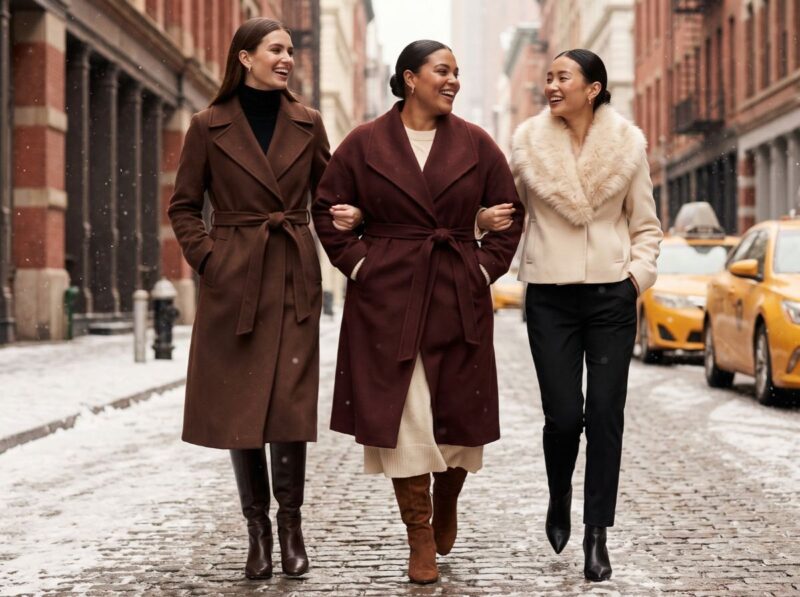
Choosing the Perfect Winter Coat for Your Body Type
For roughly four months a year, your winter coat is your outfit. That gorgeous sweater, the jeans that finally fit right, the boots you saved up for: nobody sees them from the bus stop. They see the coat. So if you’re going to spend real money on one piece of outerwear, it should be a coat that works with your proportions, keeps you warm, and makes you feel like the main character instead of a sleeping bag with legs.
The good news: you don’t need a stylist on retainer. Coats for your body type come in all shapes and sizes, and once you understand what a few coat shapes, lengths and details actually do to a silhouette, choosing a winter coat gets surprisingly simple. Whether you’re hunting for your very first investment piece or replacing a tired old favorite, this guide walks you through every major body shape, plus petite, tall, plus-size and full-bust figures, then covers length, fabric, warmth and a fitting-room checklist so you buy once and buy well. The right winter coat should be both functional and fabulous; you shouldn’t have to pick one.
One ground rule before we start: none of this is law. If you love an oversized cocoon coat on a petite frame, wear it like you mean it. Think of body-type advice as a map, not a fence.
Quick Guide: The Best Winter Coat for Each Body Type
| Body type | Coats that work beautifully | Approach with a little care |
|---|---|---|
| Hourglass | Belted wool coats, wrap coats, tailored fit-and-flare | Boxy, shapeless styles worn closed |
| Rectangle | Belted coats, double-breasted, cocoon, statement collars | Plain straight coats in flat fabric (can read boxy) |
| Pear (triangle) | A-line, structured shoulders, wide lapels, fur or statement collars | Hip-length hems, big hip pockets |
| Inverted triangle | Single-breasted, raglan sleeves, A-line, hip-level pockets | Epaulettes, heavy shoulder pads, huge collars |
| Apple (round) | Single-breasted, straight longline, open-front, V-lapels | Double-breasted closed, bulky belts at the middle |
| Petite | Hip-length to knee-length, slim lapels, monochrome | Ankle-length maxi coats, oversized volume |
| Tall | Maxi coats, long trenches, oversized cocoon | Cropped jackets with too-short sleeves |
First, Decide What You Want the Coat to Do
Before you choose a coat based on your body shape, ask a simpler question: what silhouette do you want when you walk out the door? Every coat sends the eye somewhere, drawing attention to some areas and creating the illusion of length or curves in others. Learn the levers and you can steer.
- A belt says “here’s my waist.” It creates curves on straighter figures and highlights them on curvy ones.
- A straight, single-breasted line creates one long vertical, which is elongating and slimming through the middle.
- Double-breasted buttons add width across the torso. Great for adding shape, less great if you want to minimize the bust or midsection.
- Wide lapels, big collars and structured shoulders pull attention up and broaden the top half.
- Flap pockets at the hip add volume exactly where they sit.
- Length controls proportion: a cropped coat shows more leg, a long coat creates drama and a column.
And the practical lever nobody mentions in the fitting room: your coat has to go over your winter clothes. Try it on over the chunkiest sweater you actually wear, not the thin T-shirt you happened to have on that day.
How to Find Your Body Shape in Two Minutes
Grab a soft measuring tape (or just stand in front of a mirror in fitted clothes) and compare three points: shoulders or bust, natural waist, and the widest part of your hips.
- Hourglass: shoulders and hips are roughly equal, waist clearly smaller.
- Rectangle: shoulders, waist and hips are all fairly similar.
- Pear: hips are wider than shoulders.
- Inverted triangle: shoulders or bust are wider than hips.
- Apple: weight sits mostly through the middle, often with slimmer legs.
Most women are a blend, and your shape can shift with age, hormones or a new workout habit. Pick the description that’s closest and borrow freely from its neighbors.
Best Winter Coats for an Hourglass Figure

With balanced shoulders and hips and a defined waist, you’re naturally perfectly proportioned, so the hourglass coat strategy is simple: don’t hide the waist you’ve got. Opt for coats that nip in at the right places. A coat that follows your curves looks expensive even when it isn’t.
Look for:
- Belted wool coats and wrap coats
- Tailored single-breasted coats with darts or princess seams
- Fit-and-flare and skirted coats
- Belted puffers with horizontal or chevron quilting that narrows at the waist
- Soft, drapey wool or wool-cashmere blends that move with you
Approach with care: very boxy, stiff coats worn buttoned up. They erase the waist and can make you look wider than you are.
Styling tip: already own an oversized coat you love? Wear it open over a fitted knit and slim pants so the outfit underneath defines the shape, or add your own belt. Problem solved, no shopping required.
Best Winter Coats for a Rectangle Body Shape
Rectangle figures are the most flexible coat shoppers on the planet. Your streamlined frame can go sleek and minimal or add curves on demand, depending on your mood.
Look for:
- Belted coats to create waist definition
- Double-breasted coats (peacoats, military coats) that add dimension
- Cocoon and oversized shapes that look intentionally cool on a straight frame
- Statement collars, oversized lapels, interesting pockets
- Texture: bouclé, teddy, faux fur, herringbone, plaid
Approach with care: a plain, straight coat in flat fabric with zero detail. It isn’t wrong, it can just look like a rectangle wearing a rectangle. Add texture, color or a belt and it comes alive.
Styling tip: a long, straight camel coat over a monochrome outfit is your effortless “I have my life together” uniform. Lean into it.
Best Winter Coats for a Pear-Shaped Body
If your hips are wider than your shoulders, the goal is balance: add a little interest up top and let the coat skim, not cling, over your hips.
Look for:
- A-line and swing coats that flare gently from the bust
- Structured or slightly padded shoulders
- Wide notched lapels, funnel necks, faux-fur or statement collars
- Fit-and-flare coats that nip at the waist and release over the hips
- Hems that land above or well below the widest part of the hips (waist-length or knee-length and longer)
Approach with care: coats that end exactly at the hip, bulky patch or flap pockets on the hips, and stiff straight cuts that strain across the seat when you sit.
Styling tip: a bright scarf or a coat in a lighter shade than your pants draws the eye upward. Dark straight-leg or bootcut trousers keep the lower half sleek.
Best Winter Coats for an Inverted Triangle Body Shape
Broader shoulders are a gift (hello, effortless blazers), but in a coat you’ll usually want to keep the top clean and add a bit of volume lower down.
Look for:
- Single-breasted coats with clean, unpadded shoulders
- Raglan or dropped sleeves, which soften the shoulder line
- A-line and swing coats with movement in the hem
- Hip-level flap pockets that add width below
- Narrow lapels or collarless styles, V-necklines
- Longer, fluid coats in soft wool or drapey blends
Approach with care: epaulettes, heavy shoulder pads, oversized shawl collars and puffers with big horizontal channels across the chest.
Styling tip: love a strong shoulder anyway? Own it. Pair it with wide-leg trousers or a full midi skirt so the whole look feels balanced and deliberate.
Best Winter Coats for an Apple Body Shape
If you carry more weight through the middle, vertical lines are your best friend. The right coat skims past the midsection and shows off your legs, which are often a highlight for apple shapes.
Look for:
- Single-breasted coats with a deep V or notched lapel
- Straight, longline silhouettes that fall from the shoulder
- Open-front, edge-to-edge and waterfall coats (two vertical lines down the front)
- Softly structured shoulders to frame the top
- Coats in matte, medium-weight fabrics that don’t cling
Approach with care: double-breasted coats worn closed, thick belts cinched at the tummy and very shiny, puffy channels around the middle.
Styling tip: you don’t have to wear something shapeless. A soft tie belt knotted loosely, or worn tied at the back, gives a hint of shape without a harsh line. A long scarf hanging straight down adds one more vertical.
Winter Coats for Petite, Tall, Plus-Size and Full-Bust Figures
Petite (5’4″ and under)
Proportion is everything. A coat that hits between the hip and just above the knee is the sweet spot; ankle-length coats and very oversized shapes can overwhelm a small frame. A cropped jacket is a smart choice over high-waisted pants. Choose slimmer lapels, smaller pockets and a higher button stance. A coat in the same color family as your pants and boots creates one long line. Shop petite women’s departments: shoulders and sleeves are cut shorter, which saves a tailor bill.
Tall
This is your moment for maxi coats, long belted trenches with a warm liner and dramatic oversized cocoons. Check sleeve length first: your coat sleeve should reach the base of your thumb with arms relaxed. Brands with tall ranges save you from the “wrists out in a snowstorm” problem.
Plus-size
Look for coats with real structure in the shoulders, a single-breasted front and a hem that hits at the knee or below. Wrap coats and belted coats work well if you have waist definition. Check the back: a center vent or soft A-line keeps the coat from pulling across the hips when you sit or drive. Medium-weight wool usually looks smoother than very thick, stiff felt.
Full bust
Buttons that gape across the chest are the giveaway of a coat that doesn’t fit. Size for your bust and have the waist taken in, or skip buttons altogether with wrap coats, zip-front puffers and open-front styles. A V or notched lapel is more flattering than a high, round collar.
Coat Length Guide: Which Length Flatters You?
| Length | What it does | Best for |
|---|---|---|
| Cropped / waist | Shows more leg, highlights the waist | Pear, hourglass, petite |
| Hip | Casual and practical, easy for driving | Rectangle, inverted triangle, petite |
| Mid-thigh | Versatile with jeans and pants | Most shapes, especially apple |
| Knee | Classic, works over dresses and skirts | Every body type: the safest first coat |
| Midi (mid-calf) | Elegant column, very warm | Tall, hourglass, rectangle |
| Maxi / ankle | Maximum drama and coverage | Tall figures; petites only in narrow cuts |
A useful rule: never end a coat at the widest point of whatever you’d rather not highlight. A hem draws a horizontal line, and the eye loves to stop on lines.
Coat Styles Decoded
Shopping is easier when you know what the labels mean.
- Wrap coat: no buttons, closes with a tie belt. Waist-friendly, forgiving and very flattering for hourglass and full-bust figures.
- Chesterfield / tailored overcoat: straight, single-breasted, notched lapels. A true wardrobe classic for almost every shape.
- Peacoat: short, double-breasted, wide lapels. Adds shape to rectangles and balances pears.
- Cocoon coat: rounded, oversized, narrows at the hem. Modern and cozy; best on rectangle and tall frames.
- Swing / A-line coat: fitted at the shoulders, flares toward the hem. Great for pear and inverted triangle.
- Trench coat: belted, often double-breasted. In winter, choose one with a zip-out wool or quilted liner. It suits almost every body type because the belt lets you decide how much waist to show.
- Duffle coat: toggle closures, a hood and a relaxed, slightly boxy cut in thick wool. Cozy and practical; best on rectangle, inverted triangle and petite frames in a hip or mid-thigh length.
- Peplum coat: fitted to the waist, then flares into a short skirt. It creates an instant curve, so it’s a secret weapon for rectangles and a natural fit for hourglass and pear shapes.
- Puffer: the warmest option per ounce. Choose belted or vertically quilted styles if you want shape.
- Parka: hooded, often with a drawstring waist. Practical for real cold; the drawstring creates a waist on demand.
- Teddy coat: fluffy, plush texture. Adds volume, so it suits slimmer frames and rectangles best.
- Cape and poncho coats: dramatic and fun, and especially good on pear shapes, since the volume starts at the shoulder and floats over the hips.
Can a Puffer Coat Be Flattering? Yes, With the Right Quilting
Puffers have a reputation for turning everyone into a marshmallow, but modern cuts are far smarter. Look at the quilting:
- Narrow horizontal channels look sleeker than wide, chunky ones.
- Vertical or diagonal quilting elongates, which is great for apple and petite figures.
- Belted or drawstring-waist puffers give hourglass and pear shapes their waist back.
- Longline puffers to the knee read more polished than hip-length styles.
- Matte finishes are more forgiving than high-shine nylon.
Fabric and Warmth: What Actually Keeps You Warm
A flattering coat that leaves you shivering is a bad coat. Check the label before you fall in love.
- Wool: for real winter, aim for at least 70 to 80 percent wool. Below about 50 percent, a “wool coat” is mostly polyester and won’t hold heat or shape as well.
- Cashmere and cashmere blends: softer, lighter and warmer for their weight than standard wool, but they pill more and need gentler care.
- Bouclé and melton: melton is dense, wind-resistant and structured; bouclé adds texture and visual interest.
- Down: fill power measures loft. Around 550 to 650 is good for city winters; 700+ is for serious cold. Look for responsibly sourced down certifications.
- Synthetic insulation: stays warm when damp, dries faster and is usually cheaper and vegan-friendly.
- Lining: a quilted or satin lining adds warmth and helps the coat glide over sweaters without bunching.
Match warmth to where you live. A Boston or Chicago winter calls for a different coat than one in Atlanta or Seattle, where a lined wool coat or water-resistant trench may be all you need.
Which coat for which temperature?
| Temperature | What to wear |
|---|---|
| 50–60°F (10–15°C) | Unlined trench coat, light wool jacket, quilted liner jacket |
| 35–50°F (2–10°C) | Wool or wool-blend coat, lined trench, light puffer |
| 20–35°F (-7–2°C) | Heavy wool or cashmere-blend coat with lining, mid-weight down puffer |
| Below 20°F (-7°C) | Down parka or longline puffer with high fill power, hood and wind-blocking shell |
How to stay warm without looking bulky
Warmth doesn’t have to mean volume. Layer thin and smart underneath: a merino or silk thermal base layer plus a fine-gauge cashmere sweater traps more heat than one chunky knit, and lets you choose a slimmer coat. Choose a puffer with narrow channels or a down-filled wool coat (yes, they exist) for warmth with structure. And add the heat at the edges with a scarf, gloves and a hat, rather than doubling the layers through your middle.
Warm coats without down
Prefer to skip down? Synthetic insulations such as PrimaLoft and Thinsulate keep you warm even in wet weather. Dense boiled wool, melton and wool-cashmere blends are naturally warm and breathable. Faux shearling and teddy-lined coats add serious coziness, and recycled polyester fill is now common in good-quality puffers.
Choosing a more sustainable coat
The most sustainable coat is the one you wear for ten winters, so invest in classic shapes and good construction over trend-driven pieces. Look for recycled wool or recycled polyester, certified responsible down (RDS) or wool (RWS), and coats with removable liners that stretch across seasons. Secondhand and vintage wool coats are also a brilliant, affordable option: older coats were often made with a higher wool content than today’s fast-fashion versions.
The Fitting-Room Checklist
Run through this before you hand over your card:
- Shoulder seams sit at or just past your natural shoulder (unless the style is designed dropped).
- Sleeves reach the base of your thumb with arms relaxed, and don’t ride up past your wrist when you reach forward.
- Buttons close without pulling or gaping, over a sweater.
- Hug test: cross your arms in front of you. If the back strains, size up.
- Sit test: sit down. The coat shouldn’t bunch at the hips or ride up uncomfortably.
- Collar lies flat and can be turned up against the wind.
- Length works with what you wear most: dresses, wide-leg pants or jeans.
- Pockets are real, deep and warm for your hands.
A good tailor can shorten sleeves and adjust a hem cheaply. Shoulders are expensive or impossible to fix, so prioritize shoulder fit above everything else.
Color and Pattern Tips
If you’re buying one coat for the season, neutrals earn their keep: camel, charcoal, black, navy, chocolate brown, ivory and olive go with almost everything. Camel and ivory brighten your face against winter gray; black and charcoal hide dirt and salt splashes better.
Want to play? A bold coat in cobalt, burgundy, emerald or even soft pink is the easiest way to look stylish with zero effort because the rest of your outfit can stay basic. Choose a shade that flatters your skin tone near your face.
For pattern, small checks and herringbone are subtle and slimming; large plaids add volume, so they work best on frames that want more width. Lighter colors draw attention, darker ones recede: use that on the half of your body you want to highlight or play down.
Style Tips: Common Winter Coat Mistakes to Avoid
- Buying for the size you’ll be “after the holidays” instead of the body you have now.
- Trying coats on over a T-shirt, then discovering they won’t close over a sweater.
- Choosing looks over warmth for your actual climate.
- Ignoring sleeve length because “the rest fits.”
- Letting a trend override proportion: a cropped puffer on a tall apple shape, or a floor-length coat on a petite frame, without adjusting the rest of the outfit.
- Skipping the back view in the mirror. Everyone behind you sees it.
Frequently Asked Questions
What is the most flattering coat style for all body types?
A knee-length, single-breasted wool coat with notched lapels and a slightly defined waist is the closest thing to universal. It creates a long vertical line, layers over most outfits and can be belted or worn open.
What coat length is most flattering?
Knee length is the safest and works for most heights and shapes. Petites usually look best between hip and knee, while tall women can wear midi and maxi lengths with ease.
Should a winter coat be a size bigger?
Not automatically. Try your usual size over your thickest sweater. If it closes comfortably and passes the hug test, keep your size; only go up if it pulls across the back or bust.
Are oversized coats flattering?
They can be. Oversized coats look best when something else is slim, like fitted pants or a narrow skirt, and when the shoulders still roughly line up with yours. Wear them open to show a sliver of the outfit underneath.
What is the warmest type of winter coat?
A down parka or long puffer with high fill power is the warmest. For a tailored look, a heavy wool or wool-cashmere coat with a quilted lining is the warmest classic option.
Do trench coats suit plus-size figures?
Absolutely. Choose a single-breasted or softly double-breasted trench that hits at or below the knee, with a fluid fabric that drapes rather than stands away from the body. Tie the belt loosely or at the back, or leave it open for a long vertical line.
What is a stylish but warm winter coat?
A knee-length or longer wool-cashmere coat with a quilted lining combines polish and warmth. For colder climates, a belted longline down puffer or a down-filled wool coat gives you real insulation with a chic, tailored shape.
What winter coat style is best for a minimalist wardrobe?
A single-breasted, knee-length coat in camel, charcoal, navy or black is the ultimate wardrobe staple. It works over jeans, tailored trousers and dresses, so one coat covers almost every occasion.
What coat is best for a big tummy?
A single-breasted, straight or slightly A-line coat with a V-neckline, worn open or closed with one button, skims the midsection and draws the eye vertically.
Find Your Coat, Then Wear It Everywhere
A great winter coat is an essential wardrobe piece for every woman, whatever her shape, and the perfect coat isn’t about hiding anything. It’s about choosing the lines, length and details that make you feel confident every single time you walk out the door, which, in January, is a lot of times. Start with the silhouette you want, use your body shape as a shortcut, check the fabric and fit, and then buy the one that makes you smile in the mirror. That’s the coat you’ll actually reach for, and the one that makes winter a little less gray.


